DunburyChurch of England Academy
P.S.H.E.
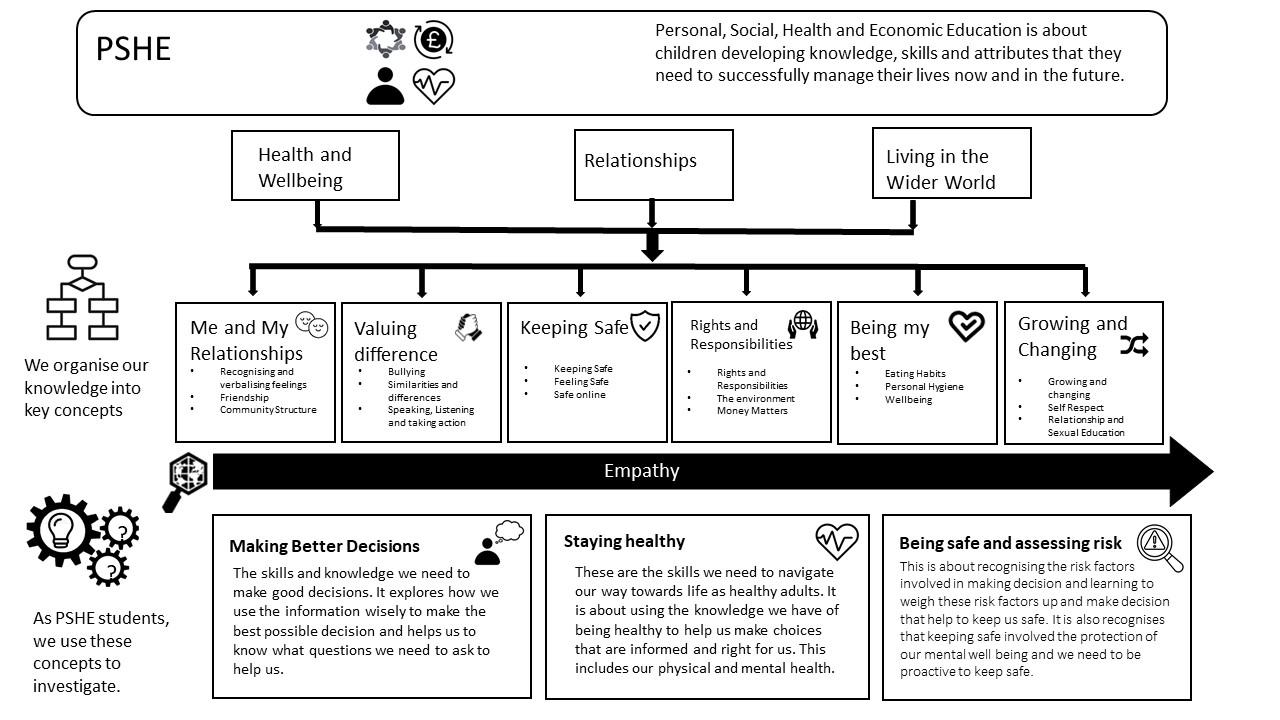
At Dunbury, we value Personal, Social, Health and Economic Education (PSHE) as one way to support children’s development as human beings, to enable them to understand and respect who they are, empower them with a voice and to equip them for life and learning. To ensure progression and a spiral curriculum, we use SCARF, the mindful approach to PSHE, as our chosen teaching and learning programme and tailor it to your children’s needs. The SCARF programme offers us a comprehensive, carefully thought-through scheme of work which brings consistency and progression to our children’s learning in this vital curriculum area.
Bullying
The Anti-Bullying Alliance (ABA) and its members have a shared definition of bullying based on research from across the world over the last 30 years.
ABA defines bullying as:
"The repetitive, intentional hurting of one person or group by another person or group, where the relationship involves an imbalance of power. It can happen face to face or online."
In school, we feel it is important to teach the children what bullying is as well as what it isn’t. Bullying is not a one-off incident or an occasional 'whoops' moment, but a purposeful reoccurring event.
Starting a conversation about what bullying is, how to recognise it and what to do if you see or experience it can help prevent bullying more effectively than sanctions imposed.
-
Anti-Bullying Alliance This charity is at the forefront of the research relating to bullying and provides excellent guidance for teachers and parents on starting the conversation about bullying. Look at the parent carer page of the website to see and access their resources to have good conversations at home that help support your child.
-
Kidscape Referenced and promoted by ABA.
-
NSPCC A well-known charity that supports children. The information is clearly laid o
Puberty
Helping your children understand changes at puberty
(Information taken from the SCARF Resources)
Children following the SCARF programme will already have a good understanding of their bodies, and how and why they change as they go through puberty.
For this age group, it's often about building on that information and developing further knowledge about the emotional changes that take place. This should take place alongside learning the reasons for the changes in more detail, including developing an understanding of how people are able to reproduce – if they want to – when they’re adults.
Parents are recognised as children's primary educators for Relationships, Sex and Health Education (RSHE), yet many feel unprepared. Often, this is because they had poor RSHE themselves – from home, school, or both.
The following information and resources are designed to support you in helping your child navigate the emotional and physical changes that take place during puberty, as well as learning about sex in the context of safe, loving relationships.
Suggested reading list for 8–11 year olds, covering reproduction/puberty/relationships/gender
- Girls Only by V Parker
- How your Body Works by Judy Hindley
- Let’s Talk About Sex by R H Harris
- Living with a Willy by N Fisher
- Sex is a Funny Word by C Silverberg and F Smyth
- The Period Book by K Gravelle
- The Puberty Book by W Darvill
- What’s Happening to Me? by P Mayle
- Alien Nation by The Proud Trust
Useful books for parents
Questions Children Ask and How to Answer Them by Dr M Stoppard
Speakeasy: Talking with your Children about Growing Up by fpa (Family Planning Association)
Useful websites for children
Amaze.org- Puberty section (Age 9+)
BBC Teach –The Big Talk (age 9-12)
Male puberty - including wet dreams
Outspoken - RSE worksheets
NHS Puberty
Useful websites for parents
Sitting in car YouTube Channel: how to talk comfortably with your kids about sex and consent
Talking to your child about online sexual harassment- a guide for parents
Other suggested RSHE Activities:
Draw around bodies
Draw around bodies and label parts, using correct words (and family names) and their purpose.
What's in the bag? Puberty
Put together your own ‘puberty bag’ from household items. Discuss each one and why it’s used, e.g. deodorant, razors, tampons/pads, shower gel, washing powder, tissues, hair gel.
What's in the bag? Growing up
Same as above for the contents of a handbag; items support discussions about growing up.
Anonymous questions box
Have an old shoebox, or similar, where children could post questions that they might not be able to ask you verbally.
Praise and thank them for their questions. Try to answer them using the webpages above to help provide age-appropriate, fact-based answers.
Relationships, Sex and Health Education
Resource list of books and websites to support good conversations with your child.
Some of the books mentioned in the above list we may have in school. Please contact school if you have a specific book that you would like to look at (we don't have them all!)
Zones of Regulation
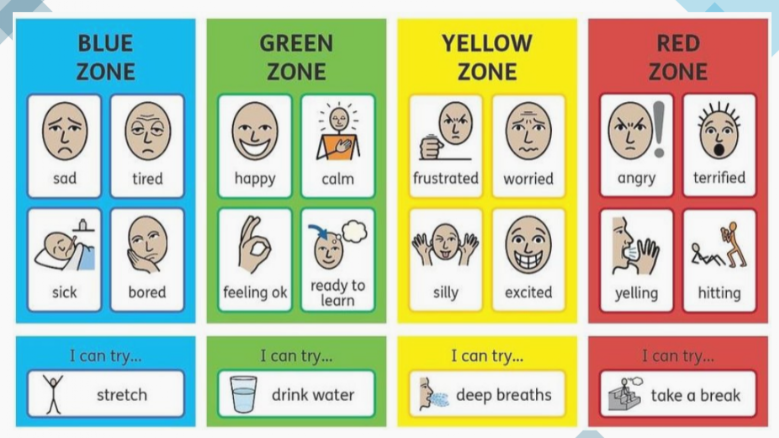
At Dunbury Academy, we actively promote children's well-being. The school uses 'Zones of Regulation', which is a research-backed framework used in many UK primary schools, designed to help children identify their emotions, manage their energy levels and develop independent self-regulation skills.
Feelings and state of mind are colour-coded into 4 zones:
1. Blue Zone - Low energy and alertness (sad, upset, bored)
2. Green Zone - Focussed and ready to learn; the optimal state for social interactions and learning (calm)
3. Yellow Zone - Heightened state but still partially in control (excited, silly, anxious)
4. Red Zone - Extremely heightened with intense emotions (angry, terrified, panic)